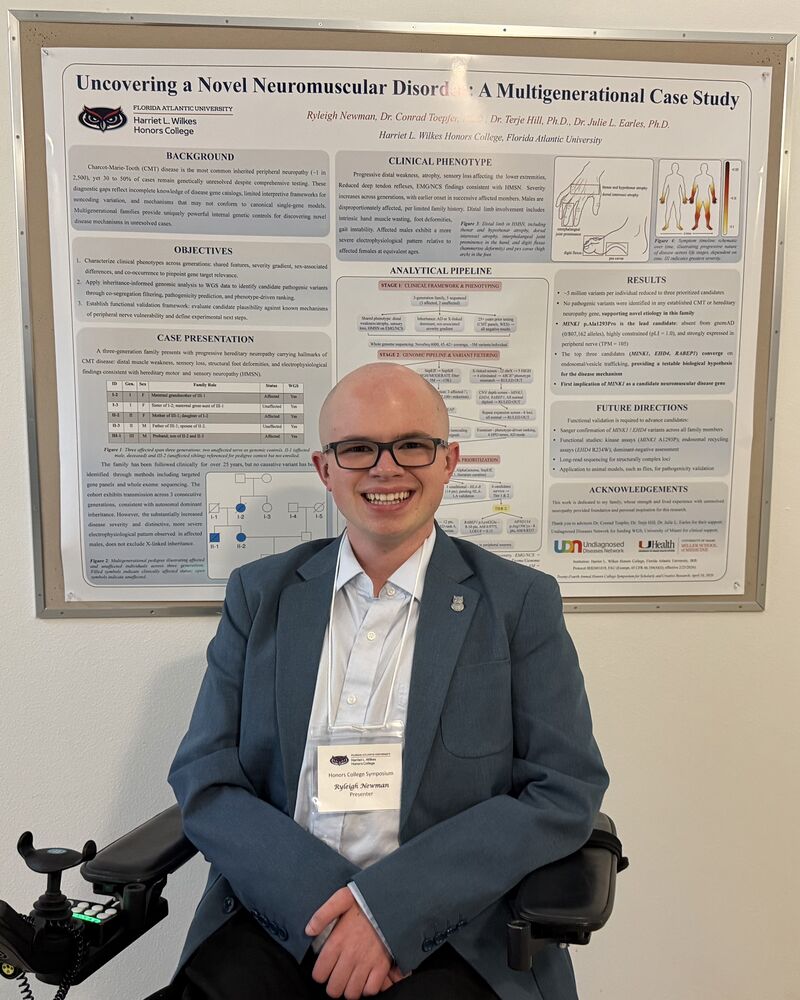
Investigating My Own DNA: My Honors Thesis
April 10, 2026 | Research
For my honors thesis I did something that still feels a little strange to say out loud. I investigated my own DNA. I live with a genetically unknown hereditary peripheral neuropathy, a condition that runs through my family and that nobody has been able to explain after more than fifteen years of testing. Most undergraduate theses end with a paper that gathers dust on a shelf. Mine was a literal attempt to read the source code of a disease I have carried my entire life. I am both the patient and the researcher in this story, and that is exactly why I wanted to do it.
Living With a Genetic Mystery
Living with a genetic mystery means living with a disease that is actively changing your body while you still do not know exactly what is happening, why, or what the road ahead looks like. The condition disrupts the nerve signals that travel from the spinal cord out to the limbs. When those signals weaken, the muscles they serve begin to deteriorate, and over time that produces a slow, progressive loss of motor function. In practical terms it looks like distal muscle weakness and wasting, foot deformities, and an unsteady gait, the kind of change you measure in years rather than days.
Clinically, what I have most closely resembles Charcot-Marie-Tooth disease, also called hereditary motor and sensory neuropathy. That is a family of inherited disorders of the peripheral nerves, and it is one of the more common inherited neurological conditions. The catch is that there are dozens of genes known to cause it, and standard genetic testing has never matched my family to any of them. Being told that you have something that looks like a named disease but does not fit any of its known genetic causes is its own particular kind of limbo. You are diagnosed and undiagnosed at the same time.
That limbo is what eventually pointed me toward a research question instead of just another clinic appointment. If the existing list of known genes could not explain my family, then maybe the explanation was sitting somewhere in our genomes that nobody had thought to look, and maybe I could be the one to go looking.
Two Goals, One Family
The project had two goals that depended on each other. The first was to carefully document my family's case. The disease shows up with variable expression across affected relatives, which means the same underlying condition presents differently from one person to the next, some more severely than others. That variability is not a footnote. It is a genuine clue, and writing it down precisely is the kind of clinical groundwork that any genetic analysis has to stand on.
The second goal was to use whole genome analysis, grounded in that clinical context, to actually start searching for the cause. The clinical picture and the genetic data were never separate efforts. The case history is what tells you which of the millions of differences in a genome are even worth a second glance. Without it, you are staring at noise.
The Method and the Pipeline
To do this I analyzed the whole genomes of myself and four other family members, including both affected and unaffected relatives. Having unaffected family members in the dataset matters more than it might sound, because a variant that truly causes the disease should generally be present in the people who have it and absent in the people who do not. My own relatives became the control group. I processed the raw sequencing data and built an initial pool of more than five million variants, which is to say more than five million places where our DNA differs from the standard human reference.
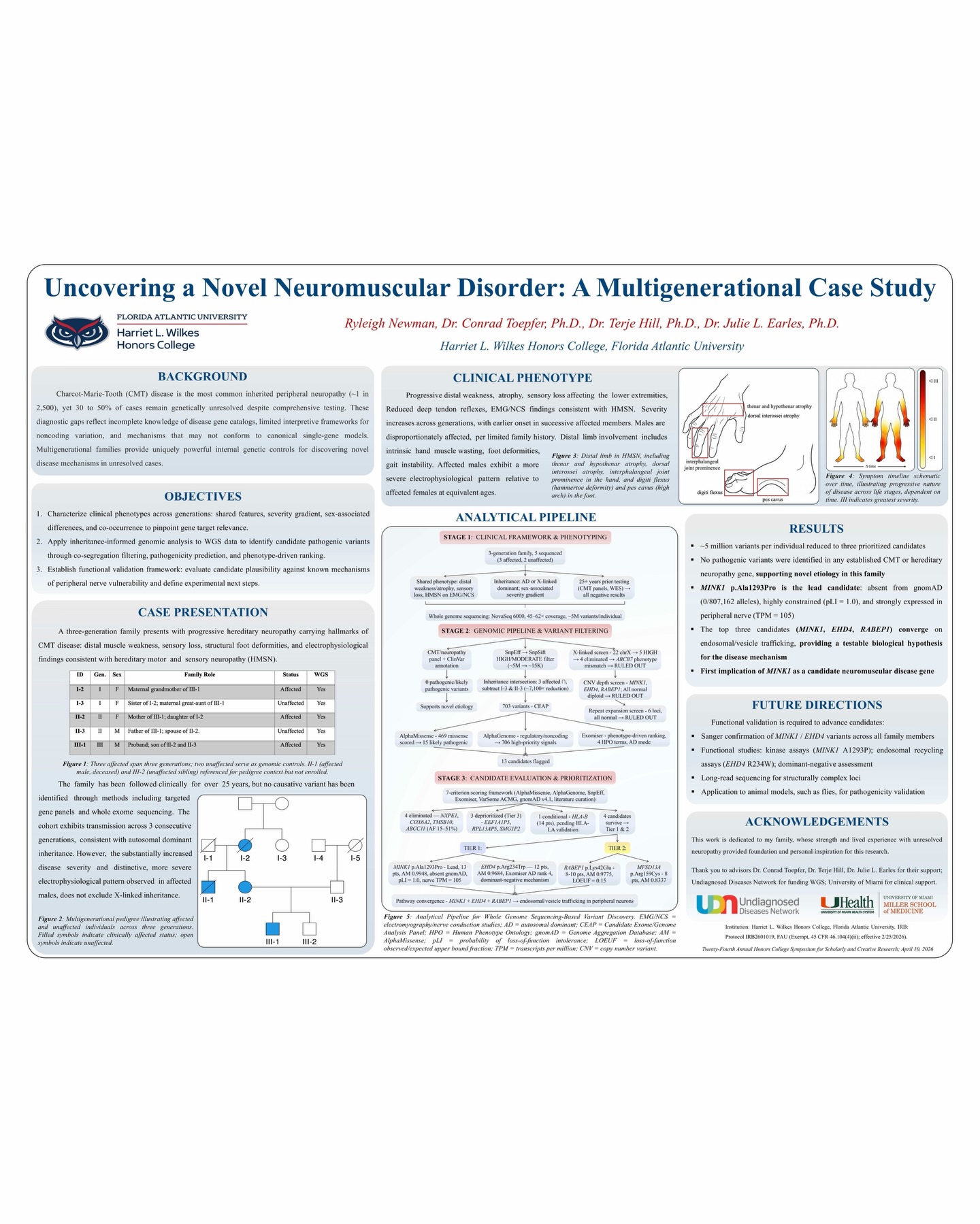
Five million is far too many to investigate by hand, so the real work was filtering. Using an analytical pipeline driven by the clinical context, I narrowed that enormous pool down to a short list of strong candidate genes. The filtering throws out common variants that show up harmlessly across the general population, then keeps the ones whose inheritance pattern fits how the disease moves through my family and whose biology plausibly connects to nerve function. It is part detective work and part bookkeeping, and the poster below is essentially the whole story compressed onto a single board.
The Results
The leading candidate to come out of that pipeline was a gene called MINK1, with two others, EHD4 and RABEP1, also landing among the top results. These are genes involved in the kind of cellular machinery that nerve cells lean on heavily, things like internal signaling and the movement of material inside the cell, so it is biologically reasonable that a disruption in one of them could interfere with the nerve function my condition affects.
I want to be honest about what this is and what it is not. This is not a final answer, and it is not a confirmed diagnosis. These are candidates, genes that fit the pattern well enough to deserve a much closer look, not proof of causation. But after more than fifteen years of dead ends, trading a blank where the diagnosis should be for a real, evidence-based starting point feels like genuine progress.
What Comes Next
I hope to come back to this work as the technology improves. The next step is functional, testing whether any of these candidates is truly causal rather than simply correlated, and that kind of validation is exactly what sequencing and analysis tools keep getting better at. If one of them does hold up, it opens real questions worth chasing, from more accurate diagnostics for families like mine to the longer-term possibility of gene-based therapies. A publication based on this work is in progress, and the thesis itself received the Outstanding Thesis Award, which I am choosing to read as encouragement to keep going.
Gratitude
The full title of the project is "Uncovering a Novel Neuromuscular Disorder: A Multigenerational Case Study," completed at the Harriet L. Wilkes Honors College at Florida Atlantic University and presented at the Honors College Symposium. None of it would have been possible alone.
This research is dedicated to my mother and grandmother, who also live with this disease, and to the broader rare disease community living without answers. I am grateful to my childhood neurologist, who connected me to researchers back in 2012, and to the University of Miami Miller School of Medicine for taking on my case. I am grateful to the Undiagnosed Diseases Network for funding the whole genome sequencing that made this analysis possible, and to my academic advisors, Dr. Conrad Toepfer, Dr. Terje Hill, and Dr. Julie L. Earles, for their guidance throughout. Most of all I am grateful to my family, who trusted me with something as sensitive as their own genetic data so that we might finally start to understand what we share.
Written by Ryleigh Newman