Broken on Board: What Inaccessible Air Travel Actually Costs
November 12, 2025 | Accessibility & Travel
A few days ago I flew back into Palm Beach International after a week in Washington, D.C. where I was competing with my university at National Model United Nations. The conference was so much fun, and I left feeling enriched after interacting with people from around the world and working on remarkable projects together. But that is not the part of the trip I keep replaying in my head. What I keep replaying is the struggle of getting on and off an airplane in my wheelchair.
I have flown with a wheelchair plenty of times, but this was my first time flying with this particular chair, which is brand new. That matters more than it probably should, and the reason is simple. My last chair was destroyed flying with Air France when I went to study abroad. After something like that you stop treating a flight as just a flight. I used to plan trips around schedules and connections. Now I plan them around the very real odds that I will land in one piece and my chair will not.
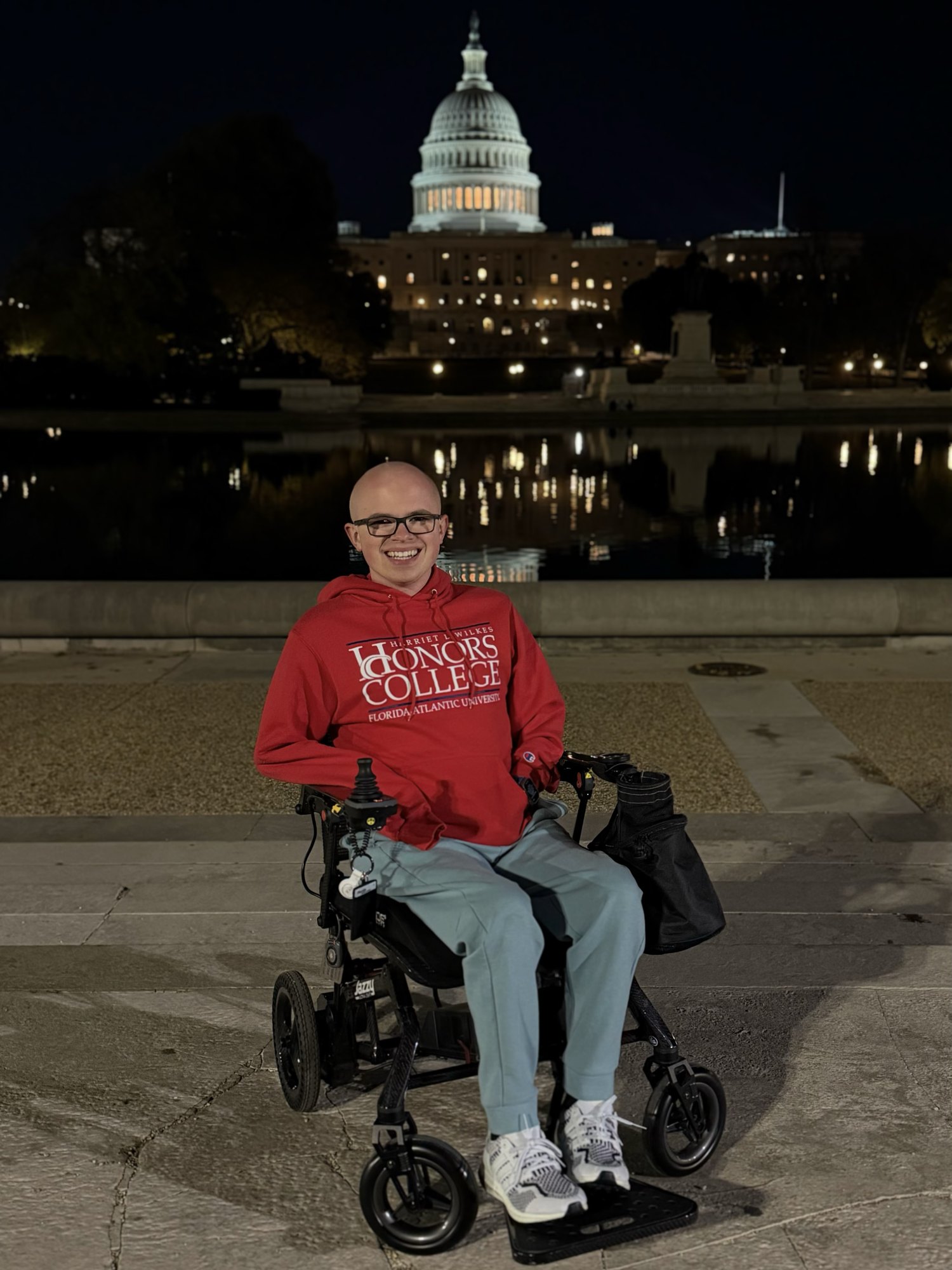
Here is the thing most people never have to think about. When a flight lands, you get that small wave of relief, the "okay, we made it" feeling. I do not get that part, which is a crazy thing to say. For me the landing is where the stress actually starts, because the real question is whether my chair even made it onto the plane at all. And if it did, is it still working, still drivable, and still safe to sit in?
The Moment I Turned Around
To get off the plane I have to be lifted into a narrow aisle chair and pulled backwards up the aisle and out the door. The whole way out you cannot see your own wheelchair. You sit there facing the wrong direction, relying on the mobility attendants to guide you out. The moment I got turned back around after being unloaded, I found my chair in multiple pieces.
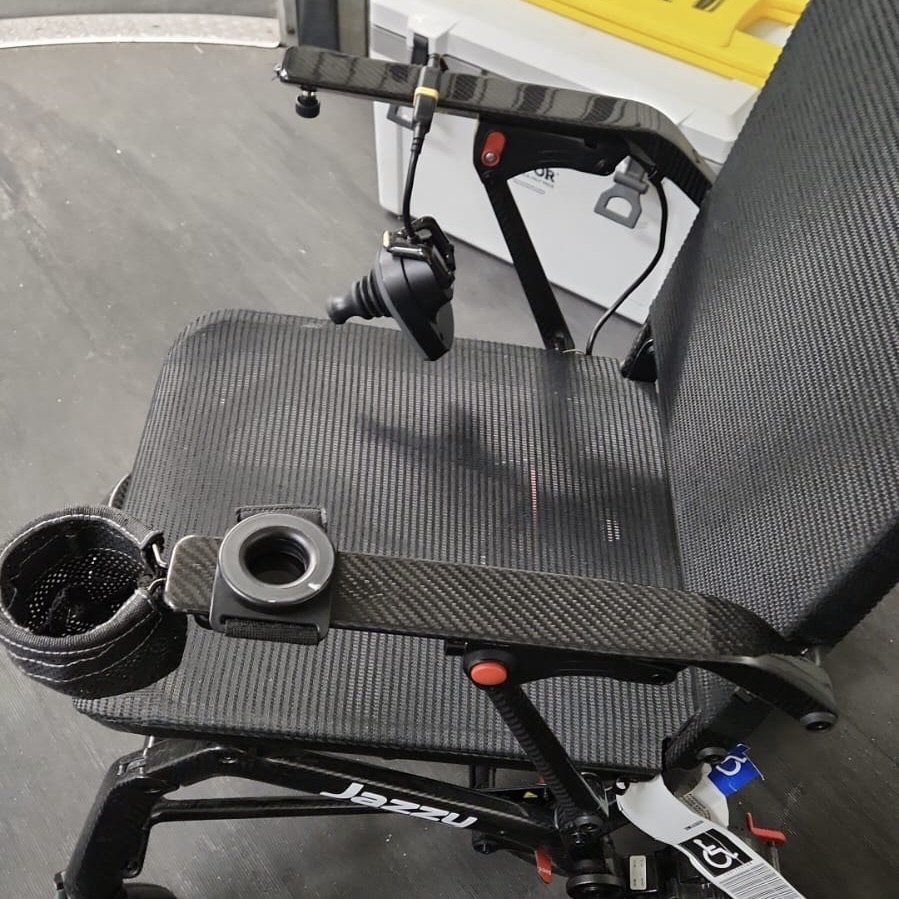
The joystick, the armrest, and the mounting bracket were snapped clean in multiple pieces. This is not a scratch or a scuff or some cosmetic thing I can shrug off and deal with later. The joystick is how I drive the chair. It is the brains of the whole wheelchair, and impossible to use without it. So I was stuck, unable to move on my own, and I could not get out of the airport unless somebody pushed me around.
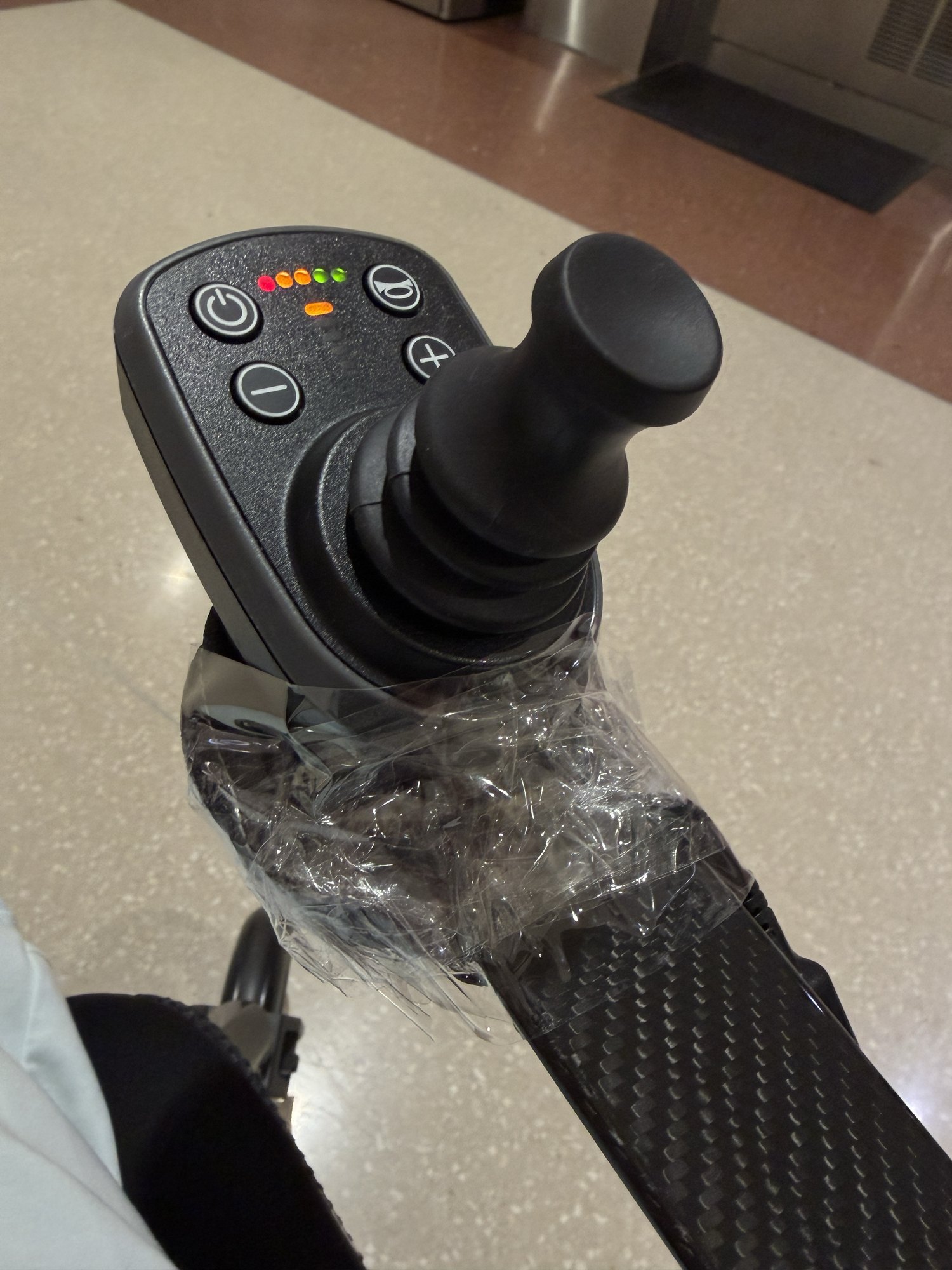
I caught the damage before I was even fully off the plane. To get out of the terminal at all, I taped the broken pieces back together and balanced the whole control arm on my cupholder, which is exactly as ridiculous as it sounds. It got me out the door, but of course it was not safe or reliable. I am grateful for the airport staff who helped me put this little fix together. A majority of wheelchair users could not have fixed this, and would have been stranded without the advocacy skills I have built up over the years.
What stings is that none of this is a freak event. There are real numbers behind it. The Department of Transportation requires airlines to report how many wheelchairs and scooters they damage or lose, and the count runs into the thousands every single year. More than ten thousand mobility devices get broken or mishandled annually across U.S. carriers, which works out to dozens of people, every day, going through some version of the evening I just had.
What It Actually Costs
When people hear "the airline broke a wheelchair," I think they picture a bent suitcase wheel and a refund. The real bill is bigger and it lands in more than one place.
- - From my experience, American Airlines replaced the damaged components at a cost of roughly $700.
- - Heavier rehab and custom chairs almost always go in cargo, where they get handled like freight and break the worst.
- - A broken chair is not a delayed inconvenience. It is an immediate loss of mobility, independence, and basic safety. Think about your legs breaking; it is the same thing for a wheelchair user.
- - For fully custom devices, a repair or replacement can run into the tens of thousands of dollars and take weeks or months to get approved and finished.
I got extremely lucky with that $700 replacement. That is technically dirt cheap for a wheelchair, but the expensive part is never the money. It is the days afterward where you cannot move around, cannot leave your house, cannot really do anything while you wait for the replacement to be ordered. You cannot go to work, you cannot go to class. Then there is the slow erosion of trust, where you start saying no to trips and to seeing the world, carrying that fear with you from every past experience. When you hear story after story like this, it stops reading as bad luck and starts reading as the predictable result of treating wheelchairs as ordinary checked bags instead of the equipment people's whole lives depend on. Worth saying clearly: you do not have to accept this quietly. The Department of Transportation's air travel disability rights resource lays out what airlines are actually required to do for passengers with disabilities, including how they must handle and compensate for damaged mobility devices. Until something changes about how the chairs are handled, though, every broken one will keep getting filed under "sad accident," when nearly all of them were preventable.
Low-Cost, High-Impact Fixes
People talk about accessibility in aviation like it would take a moonshot, some giant technological leap or a fortune in redesigned planes. Most of what would actually help is not a gadget at all. It is procedure, the boring stuff nobody wants to fund: how things get loaded, who gets trained, what gets written down before the chair disappears under the plane. Airlines are already paying for the chairs they break. If they spent a fraction of that on not breaking them, they would come out ahead and a lot of us would land safer and more independent. Here is where I would start.
1. Standardized protective crates for chairs
Airlines already know how to move fragile, expensive things without destroying them. They do it for instruments, for medical equipment, for all kinds of specialized cargo that travels in its own purpose-built case. A reusable crate designed around a power chair would absorb most of the damage that happens during loading and unloading, and it would work the same way regardless of which aircraft you are on. There is a cost up front, but it pays for itself fast once the airline stops cutting checks every time a chair comes off the belt in pieces.
2. Real crew training and one clear loading protocol
Every time I ask how my chair will be handled, or whether it can stay in the cabin, I get a different answer. That is not because the crew does not care. Almost everyone I deal with is genuinely trying to help. The problem is that nobody has given them clear instructions, so they are guessing too, and their guess is riding on my legs. A small amount of required training would let crew handle a chair without second-guessing, and it would mean I am not the one teaching a stranger how my own equipment works while a line forms behind us on the jet bridge.
3. Mandatory before-and-after photos at the gate
If a few photos got taken of the chair at the gate before it went under the plane, there would be an actual record of its condition. That alone would shut down most of the argument over who broke what, make damage claims far less miserable, and quietly remind everyone that someone is going to compare the after to the before. It costs essentially nothing. The staff are already standing right there, and they already have phones in their pockets.
4. Treat mobility devices as essential equipment, not luggage
My wheelchair is not a suitcase. It is how I move through the world, and when it breaks I am stuck, full stop. If policy started from that one fact, the whole focus would shift away from paying for damage after it happens and toward not causing it in the first place. Treating a wheelchair as essential equipment is not the airline doing me a favor. It is the floor, the bare minimum required for me to travel the same way everyone around me already does.
None of this needs new planes or a sweeping overhaul of how airports run. It needs the people in charge to decide it matters enough to bother. Accessibility is not a courtesy you add to a flight if there happens to be room left over after everything else. For someone like me it is the line between travel that works and travel that ends with me taping my own chair back together on a jet bridge, hoping it holds long enough to get me out the door, and long enough to get me home.
Written by Ryleigh Newman